 CRAFTS AND STONE
Where It Comes From
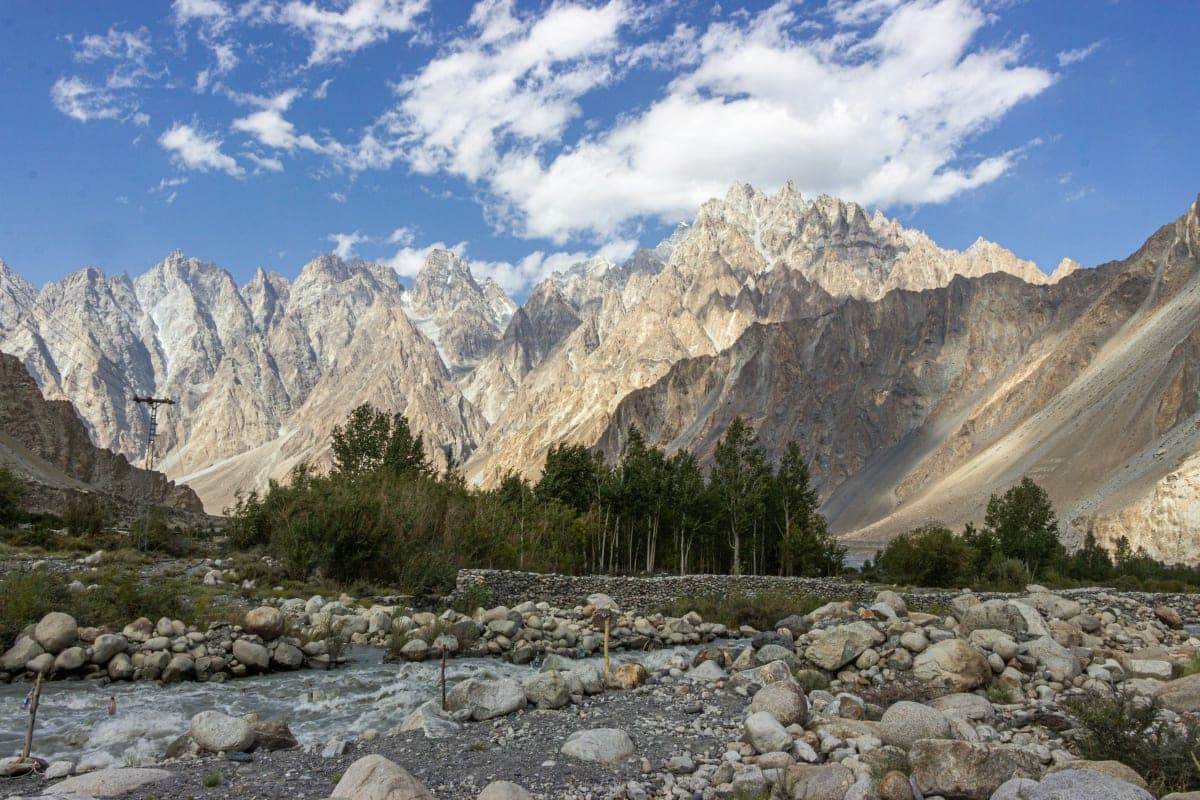
Hunza ruby comes from the Hunza and neighbouring Nagar valleys in Gilgit-Baltistan, in Pakistan's north. It sits alongside the better-documented marble-hosted ruby at Nangimali in Azad Kashmir as one of the country's two known ruby occurrences, both far smaller in output than the famous deposits of Mogok in Myanmar.
The Deposit Type
Ruby here is marble-hosted, meaning it crystallised within metamorphosed limestone or dolomite rather than in the basaltic or alluvial settings that produce ruby elsewhere. Boron-bearing fluids moving through the marble during regional metamorphism supplied the aluminium and chromium needed to grow corundum. This is the same deposit type that produced the classic Mogok material and Nangimali's ruby — a genuinely small family of localities worldwide.
Why Marble-Hosted Ruby Fluoresces
Marble is chemically very low in iron, and iron is what suppresses fluorescence in corundum. With little iron to compete, the chromium that colours these rubies red also makes them glow strongly under both ultraviolet light and ordinary daylight — the visible "glow" prized in fine Burmese ruby, and a genuine trait of this deposit type rather than a marketing description.
Color
Hunza-Nagar ruby runs from pink to red, frequently with a purplish or brownish modifier rather than the purest red. Material approaching the saturated "pigeon's blood" red associated with the finest Mogok stones is rare here, as it is nearly everywhere.
Size and Clarity
This is a small-scale, collector-grade source rather than a commercial one. Facet-grade rough above a carat or two is uncommon, and most material carries enough silk and internal clouding to suit cabochons or beads better than clean faceted stones. Buyers should calibrate expectations to modest sizes and moderate clarity.
Ruby's Frequent Companion: Spinel
Marble-hosted ruby deposits worldwide, Mogok and Nangimali included, are well known for also producing red spinel from the same or adjacent rock. The two minerals can look identical to the eye and were confused for centuries — the Black Prince's Ruby in the British Crown Jewels is in fact spinel. Refractive index and specific gravity separate them without difficulty in a lab; by eye alone, they cannot be reliably told apart.
Optical and Physical Properties
Ruby is the red, chromium-coloured variety of corundum, hardness 9 on the Mohs scale — second only to diamond among gem minerals. Refractive index runs approximately 1.762 to 1.770, specific gravity around 4.00, and it is uniaxial negative with strong dichroism, appearing purplish red down one axis and orange-red down the other.
Identification
Marble-hosted origin is indicated by low iron content, strong fluorescence, and characteristic inclusions — calcite and dolomite crystals, and often a silky haze of fine rutile needles. Distinguishing Hunza specifically from Nangimali or other marble-hosted sources is a laboratory question of trace element chemistry, not something reliably done by eye.
Treatments
Heat treatment to improve colour and reduce silk is standard across the ruby trade generally, applied to the vast majority of commercial ruby regardless of origin. Lead-glass filling — a much more invasive treatment that fills fractures with glass and requires very different care — is a separate, serious disclosure issue in the wider ruby market and should always be asked about explicitly.
Durability
Ruby's hardness makes it highly resistant to scratching, one of the most durable coloured stones available for daily wear. That durability applies to untreated or simply heated material; glass-filled ruby is a different proposition and should be treated far more carefully, since the filler is soft and reacts to heat and acids.
Mining Reality
Output from Hunza and Nagar has always been small and artisanal, worked by hand in a mountainous, seasonally restricted environment. Supply is irregular by nature rather than by any current disruption, and buyers should not expect consistent availability of a particular size or grade.
Grading
Ruby is graded on colour first — hue, saturation and tone together — then clarity, then cut and carat weight. Because so much ruby on the market is treated to some degree, the grading conversation is inseparable from the treatment conversation: two stones of identical apparent colour can be worth very different amounts depending on what produced that colour.
Pricing
Small, moderately included marble-hosted ruby from Hunza or Nagar is priced well below fine Burmese material and below Nangimali's better-known output. Its value to a buyer is largely about rarity and origin story rather than size or flawless clarity — an honest, modest stone rather than an investment-grade one.
Care
Clean with warm water and a soft brush; ruby's hardness tolerates an ultrasonic cleaner only if the stone is untreated or simply heated, never if it has been glass-filled or contains significant fractures. When in doubt about treatment, clean by hand only.
Common Misconceptions
That all Pakistani ruby is marble-hosted the same way as Mogok's finest: the deposit type is shared, but the output quality is not, and buyers should not expect Mogok-grade material at Hunza prices. That small size means low value: rarity and honest provenance carry their own worth here, separate from carat weight. That ruby and spinel can be told apart by eye: they generally cannot, and a stone sold as one without testing could reasonably be the other.